

Specification
| Description | Recombinant protein from the full-length sequence of Homo sapiens phosphatidylinositol-5-phosphate 4-kinase type 2 alpha (PIP4K2A), transcript variant 1 (NM_005028). |
| Organism | Homo sapiens (Human) |
| Expression Host | Human Cells |
| Tag Info | His or DYKDDDDK. Please contact us if you need further information or require specific designed tag. |
| Purity | Greater than 90% by SDS-PAGE gel |
| Uniprot ID | P48426 |
| Entry Name | PI42A_HUMAN |
| Gene Names | PIP4K2A PI5P4KA PIP5K2 PIP5K2A |
| Alternative Gene Names | PI5P4KA PIP5K2 PIP5K2A |
| Alternative Protein Names | Phosphatidylinositol 5-phosphate 4-kinase type-2 alpha (EC 2.7.1.149) (1-phosphatidylinositol 5-phosphate 4-kinase 2-alpha) (Diphosphoinositide kinase 2-alpha) (PIP5KIII) (Phosphatidylinositol 5-Phosphate 4-Kinase) (PI5P4Kalpha) (Phosphatidylinositol 5-phosphate 4-kinase type II alpha) (PI(5)P 4-kinase type II alpha) (PIP4KII-alpha) (PtdIns(4)P-5-kinase B isoform) (PtdIns(4)P-5-kinase C isoform) (PtdIns(5)P-4-kinase isoform 2-alpha) |
| Application | Antigens, Western, ELISA and other in vitro binding or in vivo functional assays, and protein-protein interaction studies; For research & development use only! |
| Buffer | Purified protein formulated in a sterile solution of PBS buffer, pH7.2, without any preservatives |
| Endotoxin | Endotoxin level is < 0.1 ng/µg of protein (<1EU /µg) |
| Length | 406 |
| Molecular Weight(Da) | 46225 |
| Protein Sequence | (The sequence of expressed protein may have some variation from the sequence shown below. Please contact us for the exact sequence.) MATPGNLGSSVLASKTKTKKKHFVAQKVKLFRASDPLLSVLMWGVNHSINELSHVQIPVMLMPDDFKAYSKIKVDNHLFNKENMPSHFKFKEYCPMVFRNLRERFGIDDQDFQNSLTRSAPLPNDSQARSGARFHTSYDKRYIIKTITSEDVAEMHNILKKYHQYIVECHGITLLPQFLGMYRLNVDGVEIYVIVTRNVFSHRLSVYRKYDLKGSTVAREASDKEKAKELPTLKDNDFINEGQKIYIDDNNKKVFLEKLKKDVEFLAQLKLMDYSLLVGIHDVERAEQEEVECEENDGEEEGESDGTHPVGTPPDSPGNTLNSSPPLAPGEFDPNIDVYGIKCHENSPRKEVYFMAIIDILTHYDAKKKAAHAAKTVKHGAGAEISTVNPEQYSKRFLDFIGHILT |
Background
| Function | FUNCTION: Catalyzes the phosphorylation of phosphatidylinositol 5-phosphate (PtdIns5P) on the fourth hydroxyl of the myo-inositol ring, to form phosphatidylinositol 4,5-bisphosphate (PtdIns(4,5)P2) (PubMed:9367159, PubMed:23326584). Has both ATP- and GTP-dependent kinase activities (PubMed:26774281). May exert its function by regulating the levels of PtdIns5P, which functions in the cytosol by increasing AKT activity and in the nucleus signals through ING2 (PubMed:18364242). May regulate the pool of cytosolic PtdIns5P in response to the activation of tyrosine phosphorylation (By similarity). Required for lysosome-peroxisome membrane contacts and intracellular cholesterol transport through modulating peroxisomal PtdIns(4,5)P2 level (PubMed:29353240). In collaboration with PIP4K2B, has a role in mediating autophagy in times of nutrient stress (By similarity). Required for autophagosome-lysosome fusion and the regulation of cellular lipid metabolism (PubMed:31091439). May be involved in thrombopoiesis, and the terminal maturation of megakaryocytes and regulation of their size (By similarity). Negatively regulates insulin signaling through a catalytic-independent mechanism (PubMed:31091439). PIP4Ks interact with PIP5Ks and suppress PIP5K-mediated PtdIns(4,5)P2 synthesis and insulin-dependent conversion to PtdIns(3,4,5)P3 (PubMed:31091439). {ECO:0000250|UniProtKB:O70172, ECO:0000250|UniProtKB:Q9R0I8, ECO:0000269|PubMed:18364242, ECO:0000269|PubMed:23326584, ECO:0000269|PubMed:26774281, ECO:0000269|PubMed:29353240, ECO:0000269|PubMed:31091439, ECO:0000269|PubMed:9367159}. |
| Pathway | |
| Protein Families | |
| Tissue Specificity | Expressed ubiquitously, with high levels in the brain. Present in most tissues, except notably skeletal muscle and small intestine. {ECO:0000269|PubMed:7639683, ECO:0000269|PubMed:7852364}. |
QC Data
| Note | Please contact us for QC Data |
| Product Image (Reference Only) | 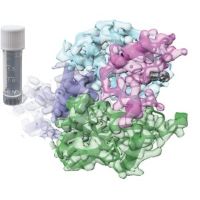 |