

Specification
| Description | Recombinant protein from the full-length sequence of homo sapiens p21 (RAC1) activated kinase 2 (PAK2) (NM_002577). |
| Organism | Homo sapiens (Human) |
| Expression Host | Human Cells |
| Tag Info | His or DYKDDDDK. Please contact us if you need further information or require specific designed tag. |
| Purity | Greater than 90% by SDS-PAGE gel |
| Uniprot ID | Q13177 |
| Entry Name | PAK2_HUMAN |
| Gene Names | PAK2 |
| Alternative Gene Names | |
| Alternative Protein Names | Serine/threonine-protein kinase PAK 2 (EC 2.7.11.1) (Gamma-PAK) (PAK65) (S6/H4 kinase) (p21-activated kinase 2) (PAK-2) (p58) [Cleaved into: PAK-2p27 (p27); PAK-2p34 (p34) (C-t-PAK2)] |
| Application | Antigens, Western, ELISA and other in vitro binding or in vivo functional assays, and protein-protein interaction studies; For research & development use only! |
| Buffer | Purified protein formulated in a sterile solution of PBS buffer, pH7.2, without any preservatives |
| Endotoxin | Endotoxin level is < 0.1 ng/µg of protein (<1EU /µg) |
| Length | 524 |
| Molecular Weight(Da) | 58043 |
| Protein Sequence | (The sequence of expressed protein may have some variation from the sequence shown below. Please contact us for the exact sequence.) MSDNGELEDKPPAPPVRMSSTIFSTGGKDPLSANHSLKPLPSVPEEKKPRHKIISIFSGTEKGSKKKEKERPEISPPSDFEHTIHVGFDAVTGEFTGMPEQWARLLQTSNITKLEQKKNPQAVLDVLKFYDSNTVKQKYLSFTPPEKDGFPSGTPALNAKGTEAPAVVTEEEDDDEETAPPVIAPRPDHTKSIYTRSVIDPVPAPVGDSHVDGAAKSLDKQKKKTKMTDEEIMEKLRTIVSIGDPKKKYTRYEKIGQGASGTVFTATDVALGQEVAIKQINLQKQPKKELIINEILVMKELKNPNIVNFLDSYLVGDELFVVMEYLAGGSLTDVVTETCMDEAQIAAVCRECLQALEFLHANQVIHRDIKSDNVLLGMEGSVKLTDFGFCAQITPEQSKRSTMVGTPYWMAPEVVTRKAYGPKVDIWSLGIMAIEMVEGEPPYLNENPLRALYLIATNGTPELQNPEKLSPIFRDFLNRCLEMDVEKRGSAKELLQHPFLKLAKPLSSLTPLIMAAKEAMKSNR |
Background
| Function | FUNCTION: Serine/threonine protein kinase that plays a role in a variety of different signaling pathways including cytoskeleton regulation, cell motility, cell cycle progression, apoptosis or proliferation. Acts as downstream effector of the small GTPases CDC42 and RAC1. Activation by the binding of active CDC42 and RAC1 results in a conformational change and a subsequent autophosphorylation on several serine and/or threonine residues. Full-length PAK2 stimulates cell survival and cell growth. Phosphorylates MAPK4 and MAPK6 and activates the downstream target MAPKAPK5, a regulator of F-actin polymerization and cell migration. Phosphorylates JUN and plays an important role in EGF-induced cell proliferation. Phosphorylates many other substrates including histone H4 to promote assembly of H3.3 and H4 into nucleosomes, BAD, ribosomal protein S6, or MBP. Additionally, associates with ARHGEF7 and GIT1 to perform kinase-independent functions such as spindle orientation control during mitosis. On the other hand, apoptotic stimuli such as DNA damage lead to caspase-mediated cleavage of PAK2, generating PAK-2p34, an active p34 fragment that translocates to the nucleus and promotes cellular apoptosis involving the JNK signaling pathway. Caspase-activated PAK2 phosphorylates MKNK1 and reduces cellular translation. {ECO:0000269|PubMed:12853446, ECO:0000269|PubMed:15234964, ECO:0000269|PubMed:16617111, ECO:0000269|PubMed:19923322, ECO:0000269|PubMed:21177766, ECO:0000269|PubMed:21317288, ECO:0000269|PubMed:21724829, ECO:0000269|PubMed:9171063}. |
| Pathway | |
| Protein Families | Protein kinase superfamily, STE Ser/Thr protein kinase family, STE20 subfamily |
| Tissue Specificity | Ubiquitously expressed. Higher levels seen in skeletal muscle, ovary, thymus and spleen. |
QC Data
| Note | Please contact us for QC Data |
| Product Image (Reference Only) | 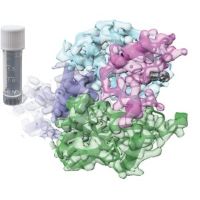 |