

Specification
| Description | Recombinant protein from the full-length sequence of Homo sapiens neuroglobin (NGB) (NM_021257). |
| Organism | Homo sapiens (Human) |
| Expression Host | Human Cells |
| Tag Info | His or DYKDDDDK. Please contact us if you need further information or require specific designed tag. |
| Purity | Greater than 90% by SDS-PAGE gel |
| Uniprot ID | Q9NPG2 |
| Entry Name | NGB_HUMAN |
| Gene Names | NGB |
| Alternative Gene Names | |
| Alternative Protein Names | Neuroglobin |
| Application | Antigens, Western, ELISA and other in vitro binding or in vivo functional assays, and protein-protein interaction studies; For research & development use only! |
| Buffer | Purified protein formulated in a sterile solution of PBS buffer, pH7.2, without any preservatives |
| Endotoxin | Endotoxin level is < 0.1 ng/µg of protein (<1EU /µg) |
| Length | 151 |
| Molecular Weight(Da) | 16933 |
| Protein Sequence | (The sequence of expressed protein may have some variation from the sequence shown below. Please contact us for the exact sequence.) MERPEPELIRQSWRAVSRSPLEHGTVLFARLFALEPDLLPLFQYNCRQFSSPEDCLSSPEFLDHIRKVMLVIDAAVTNVEDLSSLEEYLASLGRKHRAVGVKLSSFSTVGESLLYMLEKCLGPAFTPATRAAWSQLYGAVVQAMSRGWDGE |
Background
| Function | FUNCTION: Involved in oxygen transport in the brain. Hexacoordinate globin, displaying competitive binding of oxygen or the distal His residue to the iron atom. Not capable of penetrating cell membranes. The deoxygenated form exhibits nitrite reductase activity inhibiting cellular respiration via NO-binding to cytochrome c oxidase. Involved in neuroprotection during oxidative stress. May exert its anti-apoptotic activity by acting to reset the trigger level of mitochondrial cytochrome c release necessary to commit the cells to apoptosis. {ECO:0000269|PubMed:11029004, ECO:0000269|PubMed:11473128, ECO:0000269|PubMed:18416560, ECO:0000269|PubMed:21190290, ECO:0000269|PubMed:21296891}. |
| Pathway | |
| Protein Families | Globin family |
| Tissue Specificity | Predominantly expressed in brain, the strongest expression is seen in the frontal lobe, the subthalamic nucleus and the thalamus. {ECO:0000269|PubMed:11029004}. |
QC Data
| Note | Please contact us for QC Data |
| Product Image (Reference Only) | 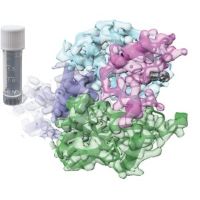 |