

Specification
| Description | Recombinant protein from the full-length sequence of Homo sapiens kallikrein related peptidase 14 (KLK14), transcript variant 2 (NM_022046). |
| Organism | Homo sapiens (Human) |
| Expression Host | Human Cells |
| Tag Info | His or DYKDDDDK. Please contact us if you need further information or require specific designed tag. |
| Purity | Greater than 90% by SDS-PAGE gel |
| Uniprot ID | Q9P0G3 |
| Entry Name | KLK14_HUMAN |
| Gene Names | KLK14 KLKL6 |
| Alternative Gene Names | KLKL6 |
| Alternative Protein Names | Kallikrein-14 (hK14) (EC 3.4.21.-) (Kallikrein-like protein 6) (KLK-L6) |
| Application | Antigens, Western, ELISA and other in vitro binding or in vivo functional assays, and protein-protein interaction studies; For research & development use only! |
| Buffer | Purified protein formulated in a sterile solution of PBS buffer, pH7.2, without any preservatives |
| Endotoxin | Endotoxin level is < 0.1 ng/µg of protein (<1EU /µg) |
| Length | 267 |
| Molecular Weight(Da) | 29122 |
| Protein Sequence | (The sequence of expressed protein may have some variation from the sequence shown below. Please contact us for the exact sequence.) MSLRVLGSGTWPSAPKMFLLLTALQVLAIAMTQSQEDENKIIGGHTCTRSSQPWQAALLAGPRRRFLCGGALLSGQWVITAAHCGRPILQVALGKHNLRRWEATQQVLRVVRQVTHPNYNSRTHDNDLMLLQLQQPARIGRAVRPIEVTQACASPGTSCRVSGWGTISSPIARYPASLQCVNINISPDEVCQKAYPRTITPGMVCAGVPQGGKDSCQGDSGGPLVCRGQLQGLVSWGMERCALPGYPGVYTNLCKYRSWIEETMRDK |
Background
| Function | FUNCTION: Serine-type endopeptidase with a dual trypsin-like and chymotrypsin-like substrate specificity. May activate/inactivate the proteinase-activated receptors F2R, F2RL1 and F2RL3 and other kallikreins including KLK1, KLK3, KLK5 and KLK11. May function in seminal clot liquefaction through direct cleavage of the semenogelin SEMG1 and SEMG2 and activation of KLK3. May function through desmoglein DSG1 cleavage in epidermal desquamation a process by which the most superficial corneocytes are shed from the skin surface. May be involved in several aspects of tumor progression including growth, invasion and angiogenesis. {ECO:0000269|PubMed:15654974, ECO:0000269|PubMed:16885167, ECO:0000269|PubMed:17158887, ECO:0000269|PubMed:17625593, ECO:0000269|PubMed:18056261, ECO:0000269|PubMed:18482984}. |
| Pathway | |
| Protein Families | Peptidase S1 family, Kallikrein subfamily |
| Tissue Specificity | Highly expressed in CNS, bone marrow and fetal liver. Also expressed in breast, thyroid, kidney, colon, pancreas, spleen, prostate, uterus, small intestine, placenta and skeletal muscle. Among 40 tissues tested, the highest expression is detected in skin followed by breast and prostate (at protein level). Expressed in stratum corneum by sweat ducts and sweat glands and detected in sweat (at protein level). {ECO:0000269|PubMed:10969073, ECO:0000269|PubMed:11309303, ECO:0000269|PubMed:11352573, ECO:0000269|PubMed:16456535, ECO:0000269|PubMed:16800737, ECO:0000269|PubMed:17110383}. |
QC Data
| Note | Please contact us for QC Data |
| Product Image (Reference Only) | 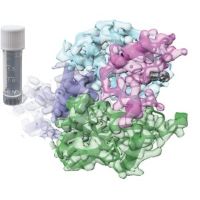 |