

Specification
| Description | Recombinant protein from the full-length sequence of homo sapiens ATP synthase, H+ transporting, mitochondrial F1 complex, delta subunit (ATP5F1D), transcript variant 2 (NM_001001975). |
| Organism | Homo sapiens (Human) |
| Expression Host | Human Cells |
| Tag Info | His or DYKDDDDK. Please contact us if you need further information or require specific designed tag. |
| Purity | Greater than 90% by SDS-PAGE gel |
| Uniprot ID | P30049 |
| Entry Name | ATPD_HUMAN |
| Gene Names | ATP5F1D ATP5D |
| Alternative Gene Names | ATP5D |
| Alternative Protein Names | ATP synthase subunit delta, mitochondrial (ATP synthase F1 subunit delta) (F-ATPase delta subunit) |
| Application | Antigens, Western, ELISA and other in vitro binding or in vivo functional assays, and protein-protein interaction studies; For research & development use only! |
| Buffer | Purified protein formulated in a sterile solution of PBS buffer, pH7.2, without any preservatives |
| Endotoxin | Endotoxin level is < 0.1 ng/µg of protein (<1EU /µg) |
| Length | 168 |
| Molecular Weight(Da) | 17490 |
| Protein Sequence | (The sequence of expressed protein may have some variation from the sequence shown below. Please contact us for the exact sequence.) MLPAALLRRPGLGRLVRHARAYAEAAAAPAAASGPNQMSFTFASPTQVFFNGANVRQVDVPTLTGAFGILAAHVPTLQVLRPGLVVVHAEDGTTSKYFVSSGSIAVNADSSVQLLAEEAVTLDMLDLGAAKANLEKAQAELVGTADEATRAEIQIRIEANEALVKALE |
Background
| Function | FUNCTION: Mitochondrial membrane ATP synthase (F(1)F(0) ATP synthase or Complex V) produces ATP from ADP in the presence of a proton gradient across the membrane which is generated by electron transport complexes of the respiratory chain (PubMed:29478781). F-type ATPases consist of two structural domains, F(1) - containing the extramembraneous catalytic core, and F(0) - containing the membrane proton channel, linked together by a central stalk and a peripheral stalk. During catalysis, ATP turnover in the catalytic domain of F(1) is coupled via a rotary mechanism of the central stalk subunits to proton translocation. Part of the complex F(1) domain and of the central stalk which is part of the complex rotary element. Rotation of the central stalk against the surrounding alpha(3)beta(3) subunits leads to hydrolysis of ATP in three separate catalytic sites on the beta subunits (PubMed:1531933). {ECO:0000269|PubMed:29478781, ECO:0000303|PubMed:1531933}. |
| Pathway | |
| Protein Families | ATPase epsilon chain family |
| Tissue Specificity |
QC Data
| Note | Please contact us for QC Data |
| Product Image (Reference Only) | 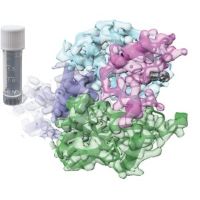 |